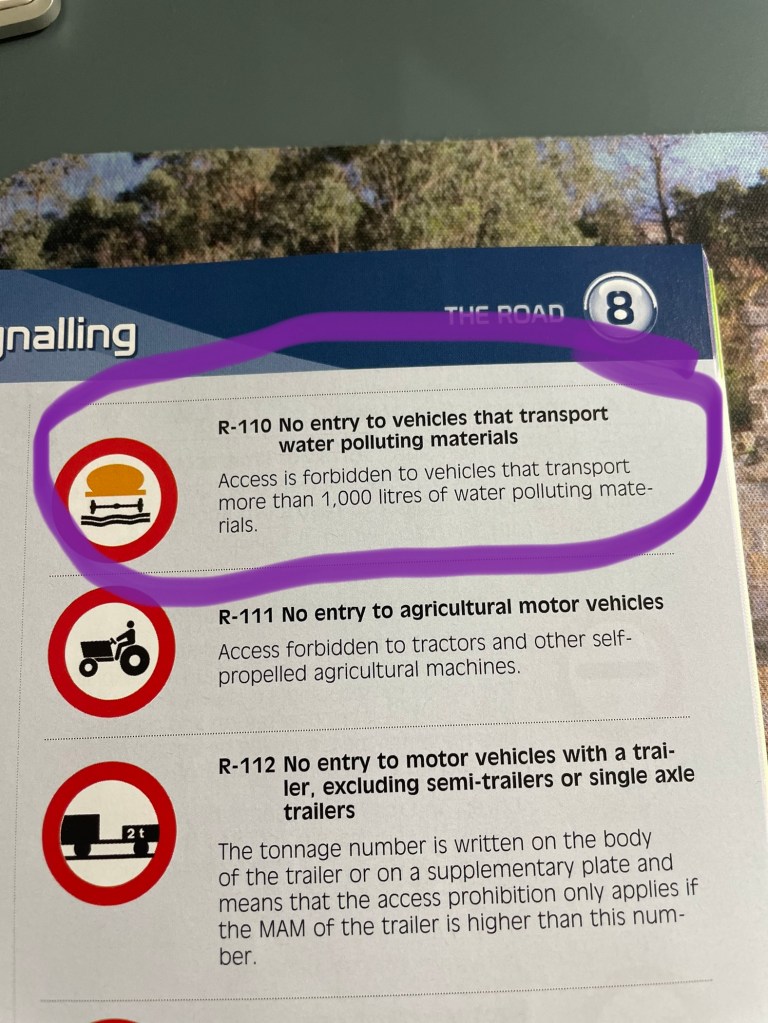
I looked at the street sign and realized I had no idea what it meant. An orange oval lay on its side attached to the horizontal orange line below it. This structure hovered over a black axle with a wheel on either side. Below all of this were three squiggly black lines. I was certain that in the 196 practice tests I’d taken, I’d never once seen this sign.
The sign was bordered in red, which always means whatever’s inside is forbidden. But what on earth was I looking at?
I skimmed through my three answer choices, all of which contained the words “driving a truck carrying hazardous materials.” Which would make sense had I decided I wanted a new life as a driver of dangerous liquids.
But I just wanted to drive a car. In Spain. Legally.
Which, I could only presume at this very moment, also somehow grants you the power to cart dangerous substances in large vehicles.
Because why else would I need to know this?
Oh. Right. Because this is Spain. And I’m a foreigner here. As such, I’ve learned over and over again that it’s best not to ask why—just accept and move on.
It’s just one question, I reminded myself. You can get three wrong. Just skip it for now.
Two questions later, a police officer was pictured facing me, his left arm raised high above his head. The tips of his shoes kissed the white line on the road in front of him. I knew that, should I encounter such a situation, I had to stop. That knowledge helped me to eliminate one of the three answer choices.
But was I supposed to stop in front of the line or in front of the police officer? What a stupid question! Whether I stopped in front of the line or in front of the officer, I was going to be in the same damn place.
I took a deep breath, let out a sigh, and did exactly what I always tell my students to do in such a situation: “Think positively. Remind yourself that you studied for this and that you will ace the test. Sure, maybe you don’t know the answer right now. But you’ll come back to it later and all will be fine.”
So I buried my fear of failing the Spanish driving test. And continued on.
Thankfully, the next few I knew right away. Which boosted my spirits until I saw the picture of the herd of sheep crossing the road. Based on the 5,300 questions I’d done in preparation for this exam (yes, really), it is important to know when animals have the right of way.
Personally, if there’s a flock of sheep crossing my direction of travel, I figure they have the right of way.
But I’d studied enough to know that rule #1 for passing this test was, “The answer that makes the most sense is not always the correct answer.” And rule #2 is to not look at the picture unless the question specifically refers to it.
Because often the picture is showing what not to do.
“When does a herd of animals have the right of way?” the question asked. None of the answers said, “If they are taking up the entire roadway in front of you.”
One option was, however, “whenever there is a sign indicating you are approaching an area where a herd of animals usually crosses under which is written the word cañeda.”
I couldn’t remember what cañeda meant. But I did remember seeing the sign in numerous practice questions and thinking, I’ve crossed paths with hundreds of animals moving from one pasture to another while walking the Camino de Santiago and never have I seen this sign.
Note that the picture accompanying the aforementioned question did not show this sign. But remember Rule #2: don’t answer the question based on the picture.
So I made a mental note to look up what cañeda meant when I broke free from this exam room and moved on.
If Michael can do this, you can do this, I reminded myself. Then I smiled recalling one of my students who, when I asked him to come up with some positive things he could tell himself while taking math tests, said, “I’m smarter than Jimmy Fallon.”
Am I smarter than Michael?
Depends on the topic.
But one thing I had on Michael was this: where as most 47-year-old adults haven’t taken a high stakes test since high school, I took one just three years ago; I spent the summer of Covid studying up on Calculus in order to pass my math teacher certification test.
But sitting in front of this computer at the Spanish equivalent of the DMV, I honestly thought that perhaps Calculus was easier than the Spanish driving rules.
It was then that I realized I could, perhaps, write off the cost of getting my drivers license as a business expense. I was, after all, putting myself in my students’ shoes, testing out the strategies I tell them to use.
Then I remembered the student I’d worked with the night before who was about to take her first SAT. “Remember most students take it at least twice, so just think of this as your test-run.” The same can be said for the Spanish Drivers license test. Ex-pat Facebook groups abound with stories of those who passed it only after multiple attempts.
In fact, the 90€ I paid for the privilege of sitting in this room entitles me to two tests.
In this game we call “Getting a Spanish Drivers License” the goal is to pass the tests without going insane. Which perhaps explains why you have to show proof of passing both medical and psychological tests before you’re even allowed to take your exam.
Here, for example, are few fun facts I had sealed off in my short-term memory, hoping to dispose of them soon:
- If you’re driving a car on a highway, your maximum allowed speed is 120km/hr.
- Unless that car is towing a trailer: then your limit is 90 km/hr.
- And the weight of the trailer had to be less that 750kg.
- And you don’t need to carry a spare tire for the trailer. Nor for your car, as long as you have a tire patch kit.
- If you have a trailer on your car and three other passengers, you better not travel in the high occupancy vehicle lane, as that’s forbidden if you’re towing a trailer.
- But you can drive in the HOV lane if you’re driving a motorcycle.
I also learned that once in a while you may have to add distilled water to the battery. For what? I have no idea. The question only asks which substance I might have to put in my battery. It doesn’t ask why.
Of course, my actual test didn’t ask me about any of the above. Instead they showed me a sign about driving hazardous materials. Which is, in fact, one of the questions I got wrong on the test.
They don’t tell you which questions you got wrong. That would help you learn from your mistakes. Which makes too much sense. And this test is not about making sense.
I know I got the question wrong because as soon as I left the examining room, I wrote down every question I could remember whose answer I wanted to look up when I got back home.
There were eight on the list.
I then went to meet Michael, who was waiting for me in a nearby coffee shop.
I should note that after Michael took his driving test, he was so unsure as to if he passed or not that he refused to speak to anyone (his wife included) until he got his test results—which you look up online eight hours after you take it.
“How do you think you did?” Michael asked me.
“I have no idea,” I said.
“That’s exactly how I felt when I took it.”
“Except that I’m still speaking to you,” I smiled.
At 6:15pm, I checked the web site for my results. In red letters, it said they had no record of me.
The Spanish government websites like to threaten things like this.
Usually in red letters.
This happened to me the week before when I went online to book my appointment to make my appointment for my test.
Yes, you read that correctly—you have to have an appointment at the DMV where you show up with your medical certificate, your application form, your credit card, and your Spanish residency card. Only then will they sign you up for another appointment to take your driving test.
Anyway, when I went to sign up online for the first appointment, I got the red letters. But thankfully, the women of the Ladies Driving in Spain Facebook group had warned me about that. “Just keep trying throughout the day and eventually it will work.”
In my haste to get my results, I’d forgotten about what they’d said the previous week and posted a frantic-but-trying-to-remain-calm message. “I was supposed to get my results at 6pm, but it’s 6:30 and they say that have no record of me!”
“I didn’t get my results til 9pm.” “Mine didn’t show up until the next day.”
The next day?! I might need Michael’s blood pressure cuff. . . .
Twenty minutes later, I tried again.
An hour later, I tried again.
Finally, at 8:30pm, there were no red letters.
I could now forget all of the useless Spanish driving facts I had stored in my head.
And should I ever find myself driving over a body of water with more than 1000 liters of water-polluting material, I’m forbidden to pass the sign circled below.
(Of you missed the first blog in this series, click here.)
 RenaissanceRebecca